Planting as public design
Lansing’s horticultural history reaches from individual street trees to formal gardens and broad park landscapes. These plantings share living material but serve different purposes. A street tree repeats along a route. A garden bed concentrates color and texture. A woodland trail reveals existing canopy and ground. Together they show how planting can organize civic space as deliberately as pavement or architecture.
The 1922 city plan treated trees, lawns and shrubs as essential to urban improvement. Harland Bartholomew encouraged home landscaping but argued that consistent street planting required public coordination. The plan’s street designs gave planting an important role, tying horticulture to the shape of daily movement.
Cooley Gardens and formal composition
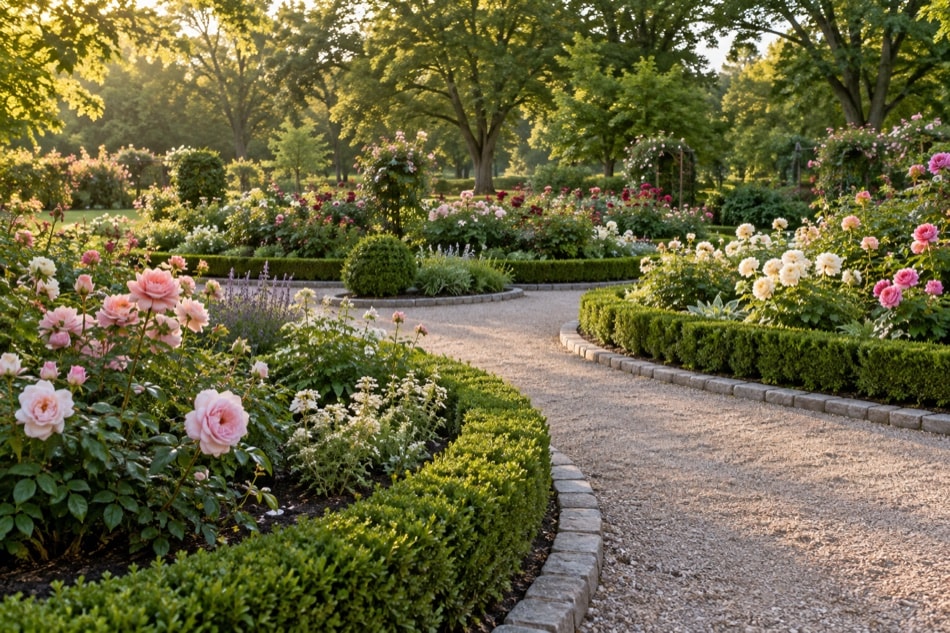
Cooley Gardens appeared among Lansing’s prominent public places. A formal garden invites attention to arrangement: the relation between path and bed, repeated shapes, framed views and changes in height. Plant choice matters, but composition turns separate specimens into a sequence. The visitor experiences the garden through movement and pause.
This page does not claim current plantings, access or condition. Gardens are especially changeable. Species are replaced, beds redesigned and weather alters every season. The durable point is that Lansing’s public landscape included a place where cultivated planting itself was the central subject.
Frances Park: rose and woodland
Frances Park brought formal and informal experiences close together. Historical material referred to an overlook and rose garden as well as a woodland trail. The pairing is revealing. Roses draw attention to bloom, color, pruning and enclosure. A woodland path shifts attention toward canopy, leaf litter, shade and the gradual change of terrain.
Moving between these settings can sharpen observation. A clipped edge makes the looseness of woodland more apparent; deep shade makes an open bed feel brighter. Public planting is most expressive when contrast is used intentionally rather than when every area is treated alike.
Street canopy as a linear garden
Residential streets can be understood as long civic gardens. Trees repeat at roughly regular intervals, their crowns meeting above the pavement as they mature. Lawns, verges and private front plantings contribute to the sequence. The result is shared even though responsibility is divided among public and private spaces.
Lansing’s 1878 shade-tree measure and later planning efforts show how early the city recognized this effect. By 1938, roughly 11,000 street trees had been planted since 1930. Those trees were not a single garden, but together they produced a citywide horticultural structure.
Gardens after loss
Disease, storms and construction interrupt planting systems. Dutch elm disease was especially disruptive because elms formed a substantial part of wet-ground and street populations. Replacement creates a different rhythm: younger trees, wider gaps and new species. A garden or streetscape is therefore never complete. It is maintained through cycles of growth, loss and renewal.
This temporality distinguishes planting from masonry. A brick wall may weather slowly, while a garden changes month by month. Planning must imagine both the immediate appearance and the mature form years later. Horticultural design is an investment in time.
Community gardening and ordinary cultivation
A community garden adds another model. Instead of a finished public composition, it offers many small plots and repeated acts of cultivation. Beds may vary in style, crop and intensity. Paths and shared edges hold the pieces together. The value lies as much in participation and season as in visual order.
That model connects civic horticulture back to Bartholomew’s encouragement of home landscape gardening. Public beauty was not imagined only as a specialist project. It could grow from many households and shared plots, provided the larger city also invested in streets, parks and coordinated planting.
A vocabulary of cultivated place
Rose bed, woodland trail, street canopy and community plot are not substitutes for one another. Each supports a different relationship to plants. Formal gardens emphasize composition; woods emphasize habitat; streets emphasize continuity; shared plots emphasize recurring care. Lansing’s landscape is richer because these forms coexist.
They also operate on different clocks. A seasonal bed can be remade quickly, while a canopy requires decades to mature. Designing with plants therefore means accepting change and planning for succession. The city’s horticultural history is as much about patient care as visual effect.