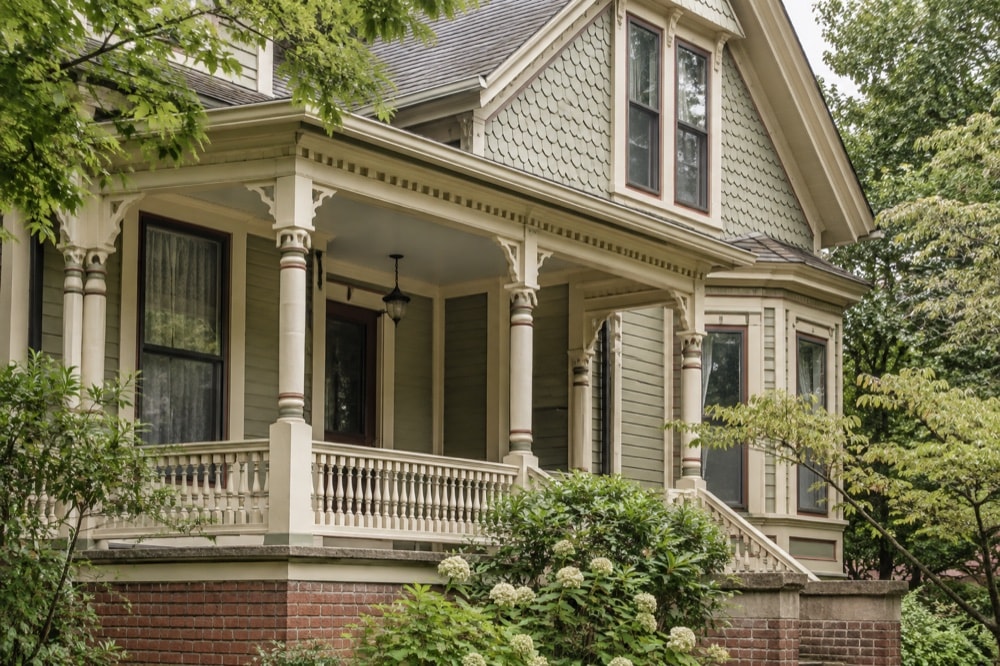
A house within a larger landscape
Turner-Dodge House is best approached not as an isolated object but as part of Old Town’s geography. It stands near the bend of the Grand River, within the area that developed from Lansing’s lower village. The waterway, early road crossing, dam, sawmill and later commercial blocks all belong to the same local story. A historic house in this setting can connect the scale of domestic life to the broader forces that made a city.
The lower village began around an early industrial foothold. John W. Burchard built a dam in 1843, and a sawmill followed in 1844. After Lansing Township was selected as the capital site, a bridge and growing road traffic encouraged shops and lodging. The settlement’s position downstream gave it its early name, while its river crossing helped it maintain an identity distinct from the middle village near the capitol grounds.
Old Town and the commercial street
Commercial buildings near the crossing were largely rebuilt between 1875 and 1920. That rebuilding produced the late Victorian business blocks now associated with the North Lansing Commercial District. The district was listed in the National Register of Historic Places in 1976. Its connected facades record a transition from pioneer settlement to a denser urban neighborhood with specialized storefronts and upper floors.
Turner-Dodge House offers a different scale of evidence. A commercial block presents repetition: bay after bay, window after window, shared walls along a public street. A house presents sequence and threshold: approach, porch, door, room and view. Placing these forms near one another gives Old Town unusual richness. The district can be read through both collective street wall and individual domestic detail.
Architecture as close observation
The safest way to look at a historic house is to begin with what is visible. Roof shape, gable, porch depth, window proportion, trim, masonry and the relation between house and lot reveal changing preferences and construction methods. Repairs and additions can be read as layers rather than defects. A building that has remained useful across generations rarely survives without change.
This guide does not identify the generic image above as Turner-Dodge House. It illustrates the kinds of porch and gable details common to nineteenth-century domestic design without claiming to depict a named landmark. That distinction keeps the visual emphasis on observation. Real places deserve to be understood through their own fabric, not through a substitute presented as fact.
The river as orientation
The Grand River bend is more than scenery. It explains the siting of the lower village and provides a connection to the Lansing River Trail. Earlier material described Turner-Dodge House as a walk along the trail from the Farmers’ Market, tying the house to a pedestrian river corridor. That relationship is historically useful even without treating any route description as current visitor guidance.
Walking beside the river changes the sequence of Old Town. The commercial district appears as an urban edge rather than a complete world; tree canopy and water remain close. Bridges become thresholds between districts. The house, market area and storefront blocks can be understood as neighboring pieces within a river-shaped landscape rather than as unrelated attractions.
Public memory without pageantry
Heritage places sometimes acquire a polished story that leaves little room for uncertainty. Turner-Dodge House is more valuable when it opens questions. How did river traffic and road traffic shape the neighborhood? What did prosperity look like in domestic architecture? Which features belong to an early building campaign, and which came later? How did Old Town’s commercial rebuilding change the social setting around the house?
Those questions return the place to the city. The house becomes a point of entry into settlement, family life, craftsmanship, landscape and public memory. Old Town becomes more than a preserved commercial image; it becomes the lower village transformed across many decades. The most honest visit, whether physical or through research, keeps both scales in view.
Close reading also leaves room for what is unknown. A building may preserve evidence without answering every question about its occupants or changes. Comparing its setting, materials and street relationship with maps and other records makes interpretation stronger while keeping certainty proportional to the evidence.