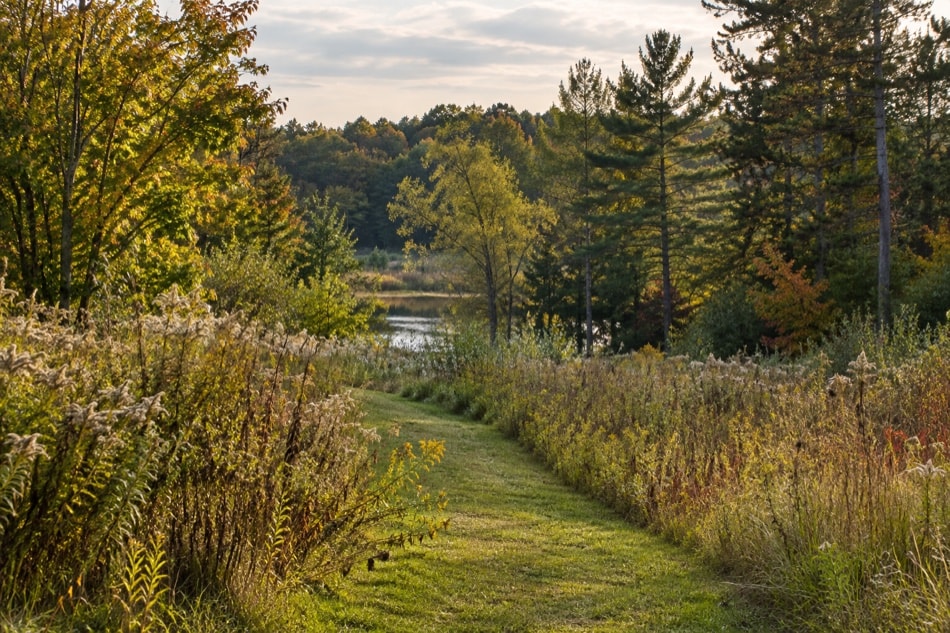
A compact mosaic of habitats
Fenner Nature Center entered Lansing’s park story in the fall of 1959 with a focus on outdoor education and environmental awareness. The center was described as roughly 130 acres containing about four miles of trails. More important than either figure was the variety packed into the site: maple groves, pine forest, swamp forest, old fields and three ponds. A short walk could move through several distinct environmental conditions.
That variety makes Fenner a useful key to Lansing’s broader landscape. The city developed within dense deciduous forest and along an extensive river floodplain. Better-drained ground and wet bottomland supported different tree communities. At Fenner, woodland, field and pond bring those contrasts into close range. The site acts as a small-scale demonstration of how water, soil and land use shape vegetation.
Reading a woodland edge
The transition from old field to woods is not a hard boundary. Grasses and sun-loving plants give way to shrubs, young trees and deeper shade. Leaf litter thickens; wind and temperature feel different. Pine creates one kind of enclosure, while a maple grove creates another. In swamp forest, wet soil changes which species can persist and how a path relates to the ground.
Edges are often the most revealing places because they show change in progress. An old field may hold evidence of earlier clearing even as woody plants return. A pond margin shifts with water levels. A trail concentrates movement while the ground beside it accumulates fallen branches, leaves and new growth. None of these conditions is static, which is part of the lesson.
Outdoor education as attention
Environmental education need not begin with a complicated label. It can begin with comparison: dry soil and wet soil, broad leaf and needle, open sun and deep shade, still pond and moving stream. Fenner’s mixed setting supported that kind of direct observation. A visitor could notice habitat differences at a human pace and return in another season to see the same ground differently.
The visitor facilities once included an exhibit room, a library and classroom. Two principal trails were described as paved, with benches placed along routes. These details belong to the center’s historical development and should not be read as current access information. Their significance is conceptual: the landscape was paired with spaces intended to help people interpret what they encountered outdoors.
Four seasonal readings
Spring emphasizes water and emergence. Low ground may appear darker and wetter, while buds reveal differences among trees before the canopy closes. Summer brings dense shade, layered green and a sharper contrast between sunny field and enclosed woodland. Autumn makes the boundary between maple, pine and open field visually explicit through color and texture.
Winter simplifies the scene. Tree form becomes easier to see, conifers hold their mass and frozen or snow-covered ground reveals small changes in elevation. A familiar path may feel entirely different without the summer canopy. Seasonal return is therefore not repetition; it is a way to test how light, water and vegetation alter the same route.
Fenner within Lansing
Fenner broadens the idea of an urban park. It is neither formal garden nor sports field, neither commercial district nor riverfront promenade. Its value comes from habitat, observation and the deliberate retention of varied ground. In a city whose history includes extensive clearing, street-tree planting and responses to tree disease, a nature center offers another form of stewardship: allowing ecological relationships to remain legible.
The site also belongs in a network of public landscapes. Compare its wet woods to the floodplain along the Grand and Red Cedar. Compare its old field to the maintained openness of a golf fairway. Compare its maple grove to planted street canopy. Each is green, but each is shaped by a different balance of water, succession, design and maintenance.
Repeated visits make those balances easier to see. A pond margin expands and contracts, shade moves as leaves emerge, and an old field gradually gathers woody growth. The lesson is not a single ideal condition. It is that habitat changes continuously, and careful observation can make those changes visible at the scale of an ordinary walk.