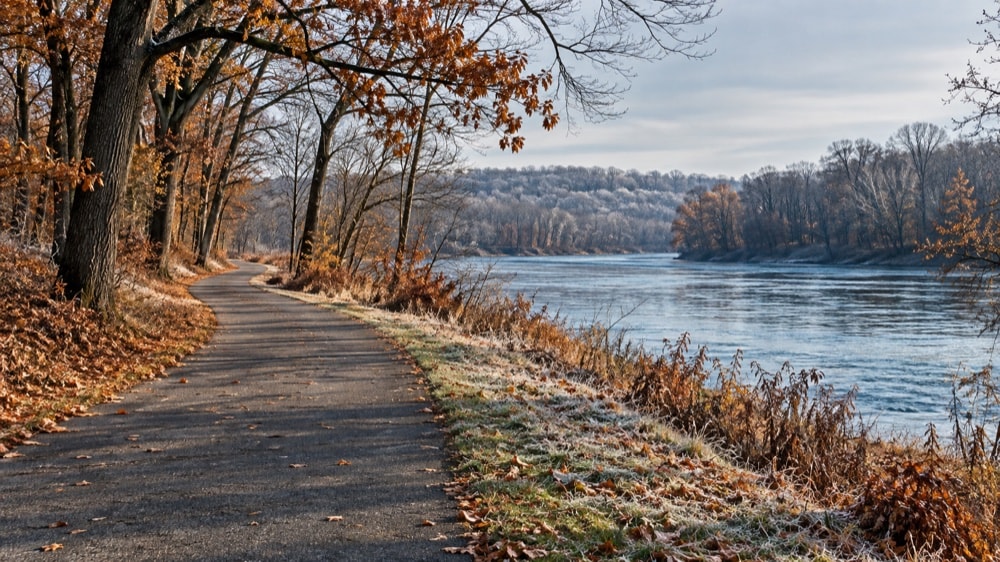
A route held together by rivers
The Lansing River Trail follows the Grand and Red Cedar corridors, linking landscapes that otherwise feel separate on a street map. Water supplies the continuity. A path may pass wooded bottomland, open park, bridge approach, neighborhood edge and a more urban reach, yet the river remains a steady reference. This makes the trail both transportation space and a long, narrow way of reading Lansing.
Flatness defines much of the experience. The rivers move through broad low ground, and the paved corridor often follows that gentle grade. A long route can therefore feel less like a sequence of climbs and more like an exercise in rhythm: steady steps, an even pedal stroke, repeated bends and the gradual change of scenery. Bridges and crossings punctuate the movement.
Walking and riding the same corridor
Walking makes details prominent. Bark texture, river sound, the edge between frost and sun, and the spacing of benches or bridges arrive one at a time. Riding compresses those moments. A curve opens quickly, distant trees approach and the relationship between districts becomes easier to grasp. Neither pace is the “correct” one; each reveals a different scale.
Shared use depends on attention. Walkers often occupy a smaller field of movement but may stop unexpectedly. Riders carry more speed and need more room to adjust. Courtesy is less about a formal script than about reading the space: sight line, path width, surface and the presence of others. On a quiet stretch the trail can feel expansive; near a junction it becomes a place of negotiation.
Four seasons on one line
Spring brings wet edges, high-looking water and the first softening of the tree line. Mud beyond the pavement can make the hard surface feel especially distinct. Summer closes the canopy and sharpens the contrast between shade and open lawn. The river may be partly screened by leaves, appearing in flashes between trunks.
Autumn opens long views through thinning branches and covers the path edge with leaves. Color can make separate tree communities easier to distinguish. Winter simplifies the corridor further. Bare limbs expose bridge geometry and river bends, while low daylight stretches shadows across the pavement. Ice, packed snow and refrozen moisture can make footing vary from one small section to the next.
Starting cold and finding a pace
A cold morning start often feels stiff simply because clothing, air and movement have not settled into a shared rhythm. The first stretch can be treated as an arrival rather than a performance. A shorter step or easy roll allows attention to shift from the parking edge or street crossing to the actual trail. Layers, gloves and daylight shape comfort more than ambition does.
On a long flat corridor, pace can become deceptively quick because there is no hill to signal effort. One ordinary approach is to leave enough ease to notice the surroundings and to turn around before the return feels like an obligation. Distance can build gradually across repeated outings rather than all at once. That is not a training program; it is simply a practical way to become familiar with a long route.
Daylight, surface and the return trip
Winter daylight changes quickly, especially beneath trees. A route that feels bright on the outward leg may be dimmer on the return. Surface color can also conceal patches where meltwater has frozen again. Looking ahead, shortening a stride where the path is uncertain and allowing extra time are ordinary responses to seasonal footing.
Riding introduces its own seasonal feel. Cold air is more noticeable at speed, leaf piles can hide a pavement edge, and shaded sections may remain slick after sunny stretches have dried. Walking the same corridor later can reveal why a turn or bridge approach felt different from the bicycle. Changing mode is another way to learn the route.
Connection as the main experience
The trail’s civic value is easy to see without making grand claims. It gives separated parks and river reaches a continuous line. It lets a person move through the city without experiencing every transition from inside a vehicle. It turns the confluence of rivers, the location of bridges and the presence of floodplain trees into an everyday sequence rather than an abstract map.
That connection also changes distance. A destination beside the river may feel closer when the route between is legible and continuous. A neighborhood edge becomes part of a longer landscape. The ordinary act of walking or riding reveals how Lansing’s pieces touch—one bend, crossing and season at a time.