Before the factory city
Lansing’s first industry grew from the river landscape. A dam and sawmill anchored the lower village before the capital decision. Milling turned water and timber into an economic foothold, while road crossings drew commerce nearby. These activities were modest compared with later factories, but they established a pattern: transport, power and available land shaped where production could occur.
The capital brought public construction and administrative employment, yet it did not define the city’s entire economy. Lansing’s growth depended on its ability to connect state functions with trade, building and manufacturing. That diversification accelerated after rail lines reached the city.
Four railroads and a wider region
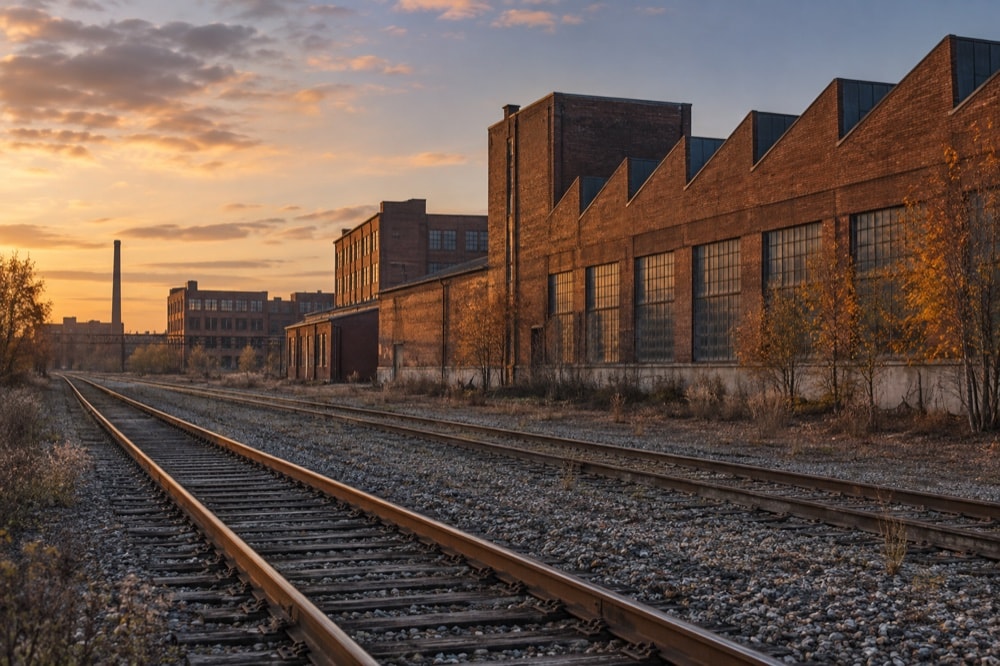
Four railroads were routed through Lansing between 1863 and 1873. Rail compressed distance for heavy goods and opened access to wider markets. It also left a durable physical pattern: tracks, sidings, warehouse zones and industrial parcels that cut across or paralleled the street grid.
Rail arrival coincided with the construction of the permanent state capitol from 1872 to 1878 and a period of urban growth. The Panic of 1873 briefly slowed development, yet building resumed. Commercial blocks and homes filled more of the original plat while industrial activity gained a stronger base.
The automobile industry
By 1900, Lansing’s expanding automobile industry contributed strongly to population and outward growth. Large tracts near the lightly built fringe could accommodate plants and related facilities. The industry changed the scale of production and the rhythm of work, while its land demands pulled the city beyond the compact nineteenth-century core.
No company, marque, model or supplier is named here. The industrial story can be told honestly without turning it into brand history. What matters for city form is the presence of large plants, the jobs they concentrated, the transport networks they required and the neighborhoods that grew within reach.
Factory scale and urban texture
A factory district produces a different landscape from a commercial street. Buildings are deeper, windows repeat over long walls and roof forms respond to large work floors. Rail sidings and service yards widen the space between structures. The pedestrian scale of storefronts gives way to gates, loading edges and long blocks.
These differences influence nearby neighborhoods. Worker housing, corner commerce and transit routes often develop around industrial concentrations. Shift changes alter street rhythms. Even after production patterns change, the size of parcels and the alignment of tracks continue to shape redevelopment.
Growth at the fringe
The historical account connected automobile production to expansion along thinly built edges where large land tracts were available. This outward movement paralleled a broader change in Lansing’s shape. Residential areas extended, public systems reached farther and the relationship between center and edge became more complex.
Mid-century annexation amplified that pattern. The city more than doubled its land area between 1956 and 1965. Industrial growth was not the only cause, but a larger urban economy required room for workplaces, housing, roads and civic facilities. The municipal boundary followed a city that had already spread beyond its early villages.
Industry and the river city
Industrial Lansing did not replace river Lansing. Tracks and plants occupied the same broad landscape as floodplain, street canopy and parkland. Wastewater systems and engineering became more important as the city grew. Riverbank improvement and recreation planning proceeded alongside industrial expansion.
This overlap is essential. A city is rarely only industrial, governmental or residential. Lansing’s identity emerged from the proximity of all three, with rivers and roads passing among them. The most revealing views are often transitional: factory wall beside neighborhood street, rail line near commercial block, or park path beneath the silhouette of industrial land.
Reading industry without nostalgia
Industrial history can be celebrated too simply or dismissed as a vanished economy. A better reading acknowledges both production and its spatial consequences. Factories supported livelihoods and city growth; they also demanded land, infrastructure and adaptation. Their buildings and corridors remain evidence even when uses change.
Lansing’s industrial century belongs within the larger civic story because it altered population, neighborhood development and the physical reach of the city. Rail and automobile production made the capital more than an administrative center. They gave it another scale—one measured in long roofs, repeated windows, tracks and outward growth.